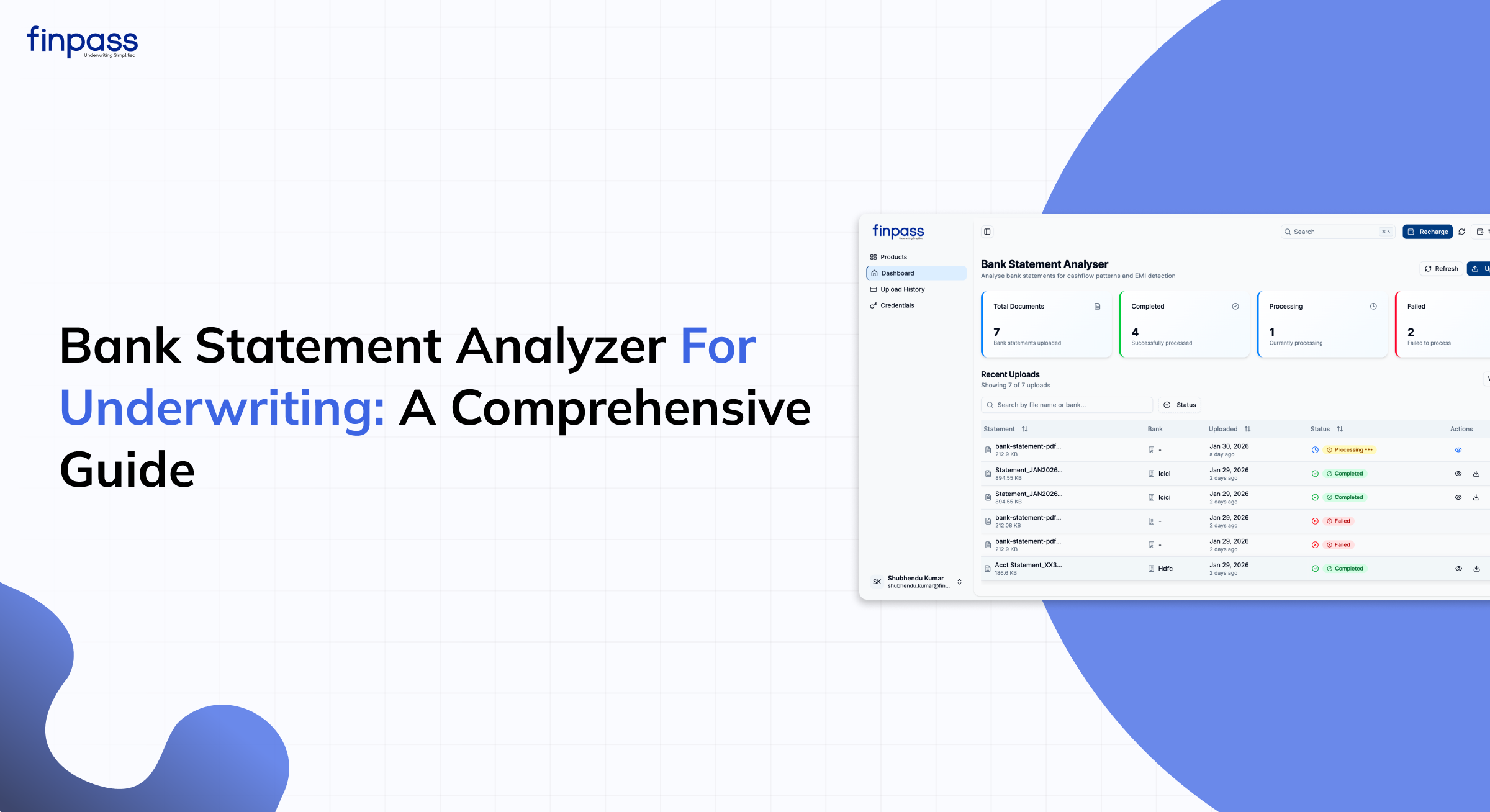
The loan underwriting process has traditionally been slow, paper-heavy, and prone to human error. Bank statement analysis — one of the most critical steps in credit assessment — used to require analysts to manually review months of transaction records, categorise expenses, and compute cash flows. Today, AI-powered bank statement analyzers have changed that entirely.
What is a Bank Statement Analyzer?
A Bank Statement Analyzer is an AI-powered software tool that automatically extracts, categorises, and analyses financial transactions from bank statements. It converts raw PDF or digital bank statements into structured financial intelligence — income patterns, expense categories, EMI obligations, average monthly balances, cash flow trends, and fraud indicators — within seconds.
Unlike manual review or basic OCR tools, modern bank statement analyzers use machine learning models trained on millions of transactions to accurately classify credits, debits, and patterns across 200+ Indian banks and NBFCs.
How Bank Statement Analysis Transforms Loan Underwriting
For NBFCs and digital lenders, the underwriting decision — approve, reject, or escalate — depends heavily on understanding a borrower's true financial behaviour. Here's how a bank statement analyzer powers better underwriting:
1. Average Monthly Balance (AMB) Assessment
The AMB reveals a borrower's liquidity cushion. Low AMB relative to EMI obligations signals repayment stress. An analyzer computes AMB across rolling 3, 6, and 12-month windows automatically, flagging borrowers where AMB consistently drops below a threshold.
2. Salary & Income Verification
The analyzer identifies regular salary credits from employers, detects month-to-month variability, and flags supplemental income sources (freelance, rental, dividends). This gives lenders a reliable net take-home figure — far more accurate than self-declared income on application forms.
3. Expense Categorisation
Transactions are automatically mapped to categories: utilities, groceries, entertainment, insurance premiums, loan repayments, and more. High discretionary spending relative to income is a risk signal. Lenders can set custom thresholds for their risk appetite.
4. Existing EMI & Obligation Detection
Perhaps the most critical function. The analyzer identifies recurring debit patterns that indicate existing loan EMIs, credit card bills, or other fixed obligations. This enables accurate FOIR (Fixed Obligation to Income Ratio) calculation — the primary metric for personal and MSME lending.
5. Cash Flow Analysis
Monthly net cash flow (credits minus debits) trends show whether a borrower's financial position is improving or deteriorating. A declining trend over 6 months is a key early warning indicator, even if the borrower's credit bureau score looks healthy.
6. Cheque Bounce & Return Detection
Inward and outward cheque bounces, ECS/NACH return transactions, and overdraft usage are automatically flagged. These are strong predictors of near-term default and are often missed in manual review under time pressure.
Manual Review vs Automated Bank Statement Analysis
Dimension | Manual Review | Automated BSA (Finpass)
- Processing time: 2–3 days per application: Under 2 seconds
- Accuracy: 70–80% (human error): 99.5%
- Transaction categorisation: Partial, inconsistent: Full, 200+ categories
- Fraud signal detection: Limited: AI-powered, real-time
- Cost per analysis: High (analyst hours): 90% lower
- Scalability: Linear with headcount: Unlimited API throughput
- Audit trail: Paper-based: Digital, searchable
How a Bank Statement Analyzer Works: Step by Step
- Document ingestion — The borrower uploads a PDF bank statement (password-protected or plain) or the lender fetches it via Account Aggregator. The system accepts statements from 200+ Indian banks.
- OCR + data extraction — A hybrid OCR engine converts scanned or native PDFs into structured transaction rows, preserving date, description, debit, credit, and balance fields.
- Transaction classification — ML models classify each transaction into income, expense, EMI, investment, or anomaly categories. Custom rule layers handle bank-specific narration formats.
- Financial metrics computation — The system computes AMB, net monthly income, FOIR, bounce rate, overdraft usage, and 40+ other metrics in real time.
- Report generation — A structured JSON API response and human-readable PDF report are returned to the lender's system, including a configurable credit risk score and approve/review/reject recommendation.
Why Finpass Bank Statement Analyser?
Finpass processes statements from over 200 Indian banks and NBFCs with 99.5% accuracy in under 2 seconds. Key differentiators:
- Multi-bank support — SBI, HDFC, ICICI, Axis, Kotak, 200+ institutions
- Password-protected PDF handling — no manual intervention needed
- Fraud detection layer — salary inflation, circular transactions, recurring anomalies
- RBI AA integration — pull statements directly via Account Aggregator consent flow
- Configurable scoring — tune thresholds for your loan product and risk appetite
- REST API + webhooks — integrates with any LOS in hours, not weeks
- SOC 2 Type II + ISO 27001 certified infrastructure
Use Cases Across Loan Products
Personal Loans
Verify take-home salary, compute FOIR with existing EMIs, detect lifestyle inflation, and flag high cash withdrawal patterns that indicate undisclosed credit usage.
MSME & Business Loans
Analyse business account turnover, GST payment regularity, vendor payment cycles, and working capital utilisation. Cross-reference with GST data for complete business health assessment.
Vehicle & Home Loans
Verify stable income over 12+ months, detect existing secured loan EMIs, and assess willingness to pay through historical repayment behaviour.
Getting Started with Finpass BSA
Finpass offers a free trial with API sandbox access. Most lenders complete integration within 2–3 business days. Our team provides dedicated onboarding support, including custom category mapping and threshold configuration for your specific loan products. Book a demo to see a live analysis of your borrower statements.
Frequently Asked Questions
What is a bank statement analyzer?
A bank statement analyzer is an AI-powered tool that automatically extracts and categorises financial transactions from bank statements to generate credit-relevant insights like income, EMIs, cash flow, and risk signals — enabling faster and more accurate loan underwriting.
How does automated bank statement analysis help in loan approval?
It replaces time-consuming manual review with instant, accurate financial intelligence. Lenders get verified income, FOIR, bounce rates, and fraud signals in under 2 seconds, enabling same-day loan approvals instead of 2–3 day turnarounds.
Which banks does Finpass BSA support?
Finpass Bank Statement Analyser supports 200+ Indian banks and NBFCs including SBI, HDFC, ICICI, Axis, Kotak, Yes Bank, IndusInd, Bank of Baroda, PNB, Canara Bank, Union Bank, and all major regional and cooperative banks.
Is bank statement analysis secure and RBI-compliant?
Yes. Finpass is SOC 2 Type II and ISO 27001 certified. All data is encrypted in transit and at rest. The platform supports the RBI Account Aggregator framework for consent-based data sharing, ensuring full regulatory compliance.
What is FOIR and how does bank statement analysis compute it?
FOIR (Fixed Obligation to Income Ratio) is the percentage of net monthly income consumed by fixed obligations like loan EMIs and credit card minimums. Bank statement analysis automatically detects all recurring debit patterns to compute precise FOIR — far more accurate than borrower-declared figures.
Can the analyzer handle password-protected PDF bank statements?
Yes. Finpass BSA handles password-protected PDFs natively. Borrowers can share passwords securely through the consent flow, and the system decrypts and processes the statement without any manual intervention.
How quickly can we integrate the Bank Statement Analyzer API?
Most lenders complete API integration within 2–3 business days using our REST API documentation and sandbox environment. Finpass provides dedicated onboarding support to ensure a smooth go-live.