_ Top Platforms Compared.webp)
Choosing the right GST analysis tool is not easy. Many platforms claim to offer faster underwriting and better credit decisions. However, every tool is different. Some focus on GST compliance, while others are built for lenders. Comparing their features takes time and effort. That's why we researched the leading GST analysis platforms in India. We compared them based on GST data coverage, lending features, fraud detection, API support, business insights, and ease of integration. This guide includes only platforms that offer dedicated GST analysis for lenders. It will help you choose the right solution for your lending business.
Why Do Lenders Need a GST Analysis Tool?
GST returns give lenders a clear picture of a business. They show monthly sales, filing history, tax payments, and overall business activity. This information helps lenders understand whether a business is financially stable before approving a loan.
Reviewing GST returns manually is slow. Underwriters often spend hours checking multiple GST reports. This increases operational costs and delays loan approvals.
A GST analysis tool solves this problem. It automatically collects GST data and converts it into easy-to-read reports. These reports highlight business turnover, sales trends, GST filing behaviour, and possible risk indicators.
A good GST Analysis tool helps lenders:
- Verify business turnover
- Check GST filing history
- Track monthly sales trends
- Detect sudden revenue changes
- Identify possible fraud
- Compare GST data with bank statements
- Reduce manual underwriting
- Speed up loan approvals
As MSME lending grows, automated GST Analysis has become an important part of modern credit assessment.
How Did We Compare these GST Analysis Tools?
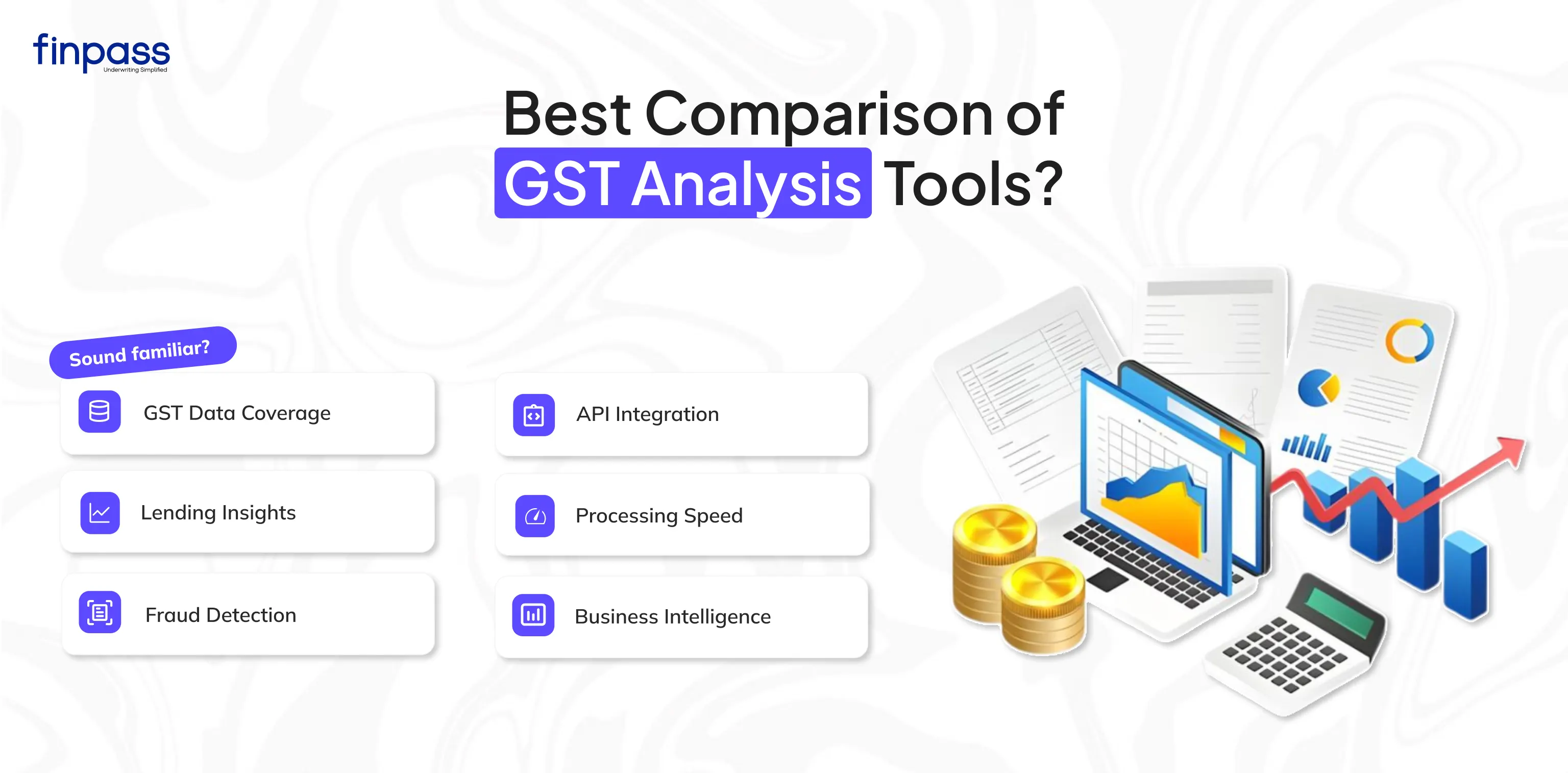
Many platforms claim to offer GST analysis. However, not every platform is designed for lenders. We compared each tool using the features that matter most during loan underwriting.
GST Data Coverage: The platform should support important GST returns such as GSTR-1, GSTR-3B, GSTR-2A or GSTR-2B, and GSTR-9.
Lending Insights: A good tool should explain business performance instead of only showing GST data.
Fraud Detection: The platform should identify unusual transactions, filing gaps, and other risk indicators.
API Integration: The tool should connect easily with Loan Origination Systems (LOS) and lending platforms.
Processing Speed: Lenders need reports within seconds to speed up customer onboarding.
Business Intelligence: The platform should provide revenue trends, turnover analysis, compliance insights, and business health indicators.
Based on these factors, three platforms stood out.
Best GST Analysis Tools for Lenders
.webp)
FinPass GST Analyser
Best for: Banks, NBFCs, Digital Lenders, and Embedded Finance Platforms
FinPass GST Analyser is built specifically for lenders. Instead of focusing only on GST compliance, it helps underwriting teams make better credit decisions. The platform analyzes GSTR-1, GSTR-3B, and GSTR-9 returns.
It verifies business turnover, tracks filing behaviour, checks Input Tax Credit (ITC) mismatches, and identifies fraud signals. FinPass also combines GST analysis with Company DNA, bank statement analysis, ITR analysis, and Account Aggregator data.
This gives lenders a complete financial view of a business from a single platform. It also offers API integration for easy deployment into existing lending systems. According to the company, FinPass serves 3,000+ BFSIs, has analysed 10M+ financial statements, delivers 99.5% accuracy, processes reports in under 2 seconds, and connects with 50+ business data sources.
Perfios GST Analyser
Best for: Large Banks and Enterprise NBFCs
Perfios GST Analyser helps lenders collect GST data with customer consent and convert it into structured underwriting reports. The platform analyzes monthly turnover, revenue trends, GST filing history, and related-party transactions.
It also detects fraud indicators and supports reports in JSON, Excel, and PDF formats. Perfios integrates with Loan Origination Systems (LOS), Loan Management Systems (LMS), and Account Aggregator workflows, making it suitable for large lending organizations.
Across its financial document ecosystem, Perfios reports processing 5 billion+ financial transactions, 10 crore+ financial statements every year, and supports 4,145 ePDF formats for financial document analysis.
Precisa GSTR Analysis
Best for: MSME Lenders and Credit Risk Teams
Precisa GSTR Analysis is designed to help lenders understand a borrower's financial health using GST data. The platform supports GSTR-1, GSTR-2A, GSTR-3B, and GSTIN verification. It also provides GST compliance ratings, turnover analysis, counterparty reconciliation, cyclic transaction detection, and bank statement cross-analysis.
One of its key features is the Precisa Score, which gives lenders a quick view of a business's GST-based credit profile. The platform also offers API integration, making it easier to include GST analysis in digital lending workflows.
Which GST Analysis Tool Should You Choose?
The right GST analysis tool depends on your lending requirements. Every platform has its own strengths.
Choose FinPass if you want a complete underwriting solution. It combines GST analysis with bank statement analysis, ITR analysis, Company DNA, and Account Aggregator data. This makes it a strong choice for lenders that want to reduce manual work and improve credit decisions from one platform.
Choose Perfios GST Analyser if your organization already uses the Perfios ecosystem. It offers strong enterprise integrations and detailed GST reports for large lending operations.
Choose Precisa GSTR Analysis if your main goal is GST-based credit assessment. Its compliance ratings and Precisa Score help lenders quickly understand the financial health of MSME borrowers.
Before selecting any platform, ask these questions:
- Does it support all major GST returns?
- Can it detect fraud and filing gaps?
- Does it provide lending insights instead of raw GST data?
- Can it integrate with your LOS or LMS?
- Does it generate reports in real time?
- Can it scale as your loan volume grows?
The answers will help you choose a solution that fits your business.
Conclusion
Choosing a GST analysis tool is not just about comparing features. It is about finding a platform that helps your team make faster and better lending decisions. A good solution should save time, reduce manual work, detect risks early, and fit easily into your existing lending process.
After comparing the leading GST analysis platforms in India, FinPass, Perfios, and Precisa all offer valuable capabilities for lenders. However, if you need a complete financial intelligence platform with GST analysis and multiple underwriting tools in one place, FinPass offers the broadest solution. Evaluate your lending process, compare your requirements, and choose the platform that supports your business goals today and as your loan portfolio grows.
FAQs
Ques: What should lenders look for in a GST analysis tool?
Ans: Lenders should choose a tool that supports major GST returns, provides turnover analysis, detects fraud, offers lending-specific insights, and integrates with their Loan Origination System (LOS) or Loan Management System (LMS). Fast processing and API support are also important for scaling loan operations.
Ques: How can lenders compare different GST analysis tools?
Ans: Instead of comparing only pricing, lenders should evaluate the platform's GST data coverage, fraud detection capabilities, AI-powered insights, API integration, report quality, processing speed, and compatibility with their existing lending systems.
Ques: Are GST analysis tools suitable for MSME lending?
Ans: Yes, GST analysis tools are especially useful for MSME lending because they help verify business turnover, identify seasonal sales patterns, assess repayment capacity, and detect financial inconsistencies.
Ques: Can GST analysis tools help detect loan fraud?
Ans: Yes, Many GST analysis tools highlight unusual filing patterns, turnover mismatches, inactive GST registrations, and other risk indicators. Some platforms also compare GST data with bank statements or other financial documents to identify inconsistencies before a loan is approved.