Banks and other businesses in the BFSI sector face difficulties when it comes to verifying a client's financial background. This is important to determine if a client has a steady income and is able to repay a loan can take time.
Lenders require customers to download their bank statements and then upload them to their platform. This manual process can be slow and frustrating for the customer. Many customers quit due to the complicated and lengthy process. Furthermore, PDF files can be easily modified or faked, which can lead to greater fraud risk.
An Account Aggregator solves all of these problems. It speeds up the process of collecting financial data. It is a safe, reliable, and quick alternative to uploading bank statements manually and the traditional methods of screen-scraping.
The Problem with Traditional Bank Statements
Before you can figure out the solution, it is important to know the root cause of the problem. For many years, sharing financial data in India was based on outdated methods. The lenders had to collect financial information manually.
This resulted in the following problems:
- High Drop-off Rates: Customers drop loan applications when they are required to collect 6 months of bank statements.
- Fraud Risk: The PDF statement can be modified with simple software.
- Poor Processing: The credit teams must examine and check documents.
- Raw Data: Traditional screen scraping often fails and gives messy and inorganic data.
Companies require a quick and secure, paperless method to access bank information. This is precisely when the Account Aggregator Framework India is able to help change the game.
What is an Account Aggregator?
An Account Aggregator (AGA) is a secure digital solution that permits users to access their personal financial details in a safe and secure manner. It serves as a bridge between the banks (where the customer's information is kept) in addition to the lending institution (who require the information to be able to approve loans).
- It permits financial institutions to access bank account data electronically however only after the user provides an explicit secure consent.
- RBI’s guidelines for account aggregators make sure that the data stored is secured. Account aggregators can't access, store, or sell any data. They can only transfer it from one place to another.
Account Aggregator can connect directly to the bank. Users simply need to enter a secure OTP to grant permission. After approval the lender receives your bank's statement in an uncluttered digital format. This makes digital lending information access quick, paperless, and totally safe.
Why Do Businesses Need an Account Aggregator?
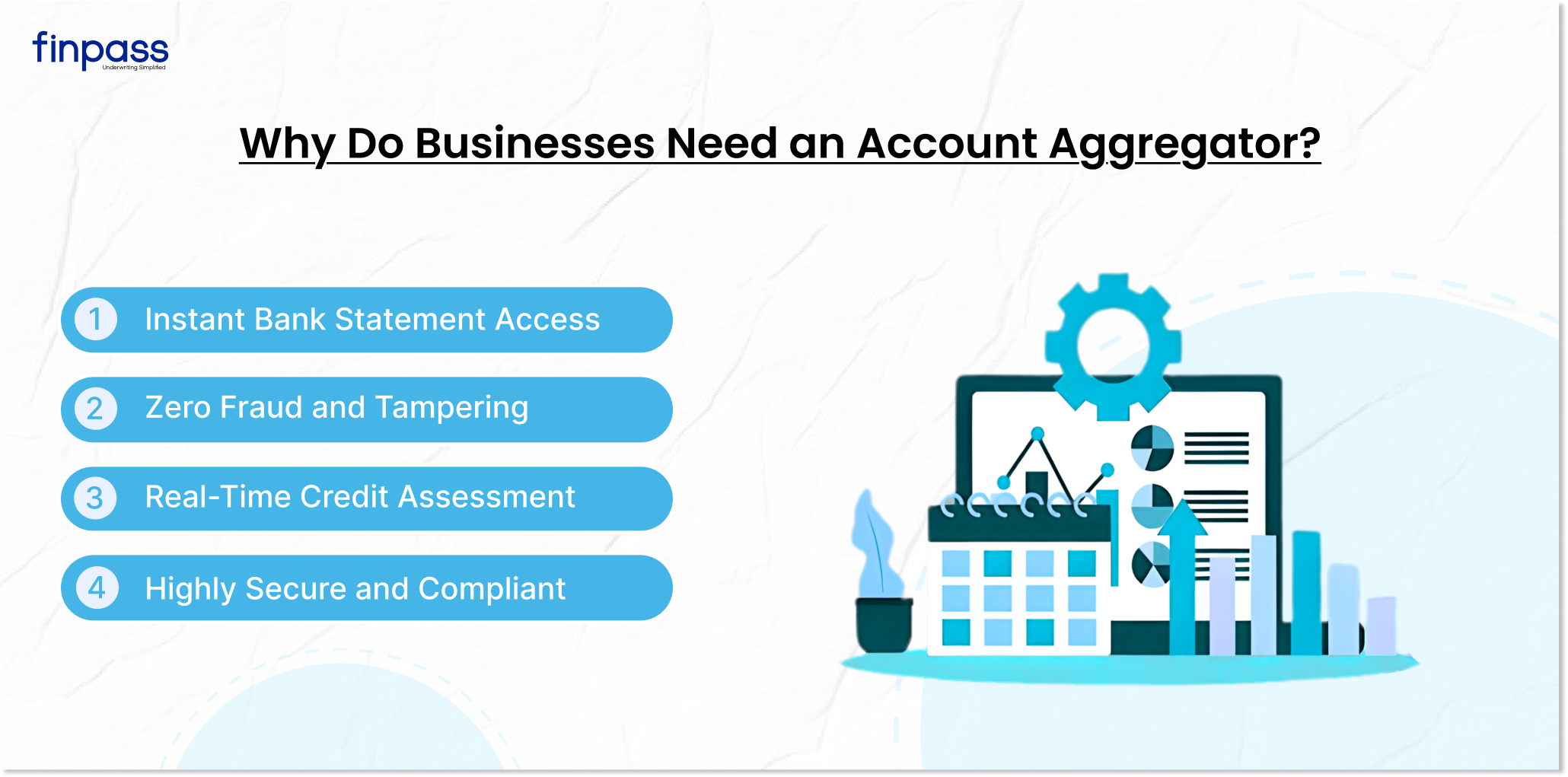
Companies require an Account Aggregator to help lenders simplify their underwriting process and increase the customer's onboarding process. Here's why it's important:
- Instant Bank Statement Access: The information is transmitted in real-time, which helps businesses to make decisions in a matter of minutes.
- Zero Fraud: The financial data is sourced directly from the financial records of the user, which makes it highly accurate. This significantly reduces the risk of fraud.
- Real-Time Credit Assessment: It works with existing banking and underwriting solutions and is able to immediately analyze the data without any human intervention.
- Highly Secure and Compliant: It operates strictly within RBI regulations. All data is secured from beginning to end, which protects both the company and the user.
Key Features of an Account Aggregator
Before choosing the or an Account Aggregator, companies must look for these important characteristics:
- Consent-Based Access to Data: Account Aggregator can only access user data once they have given their consent.
- Secure and Encrypted Transfer: It employs high-level encryption on the user's financial information. The account aggregator does not store the user’s data.
- Real-Time Data Recovery: The solution can retrieve and provide financial data in real-time without any delays.
- Standardized Data Format: This format is expected to provide information in a clear, organized form (like JSON or XML). This allows the software of the lender to process and analyze data automatically.
- Multi-bank Connectivity: The system is able to connect successfully with a range of private and public sector banks throughout the country.
- Compliant to RBI Framework: It is compliant with RBI guidelines for account aggregator.
How Account Aggregator Helps in Loan Approval?
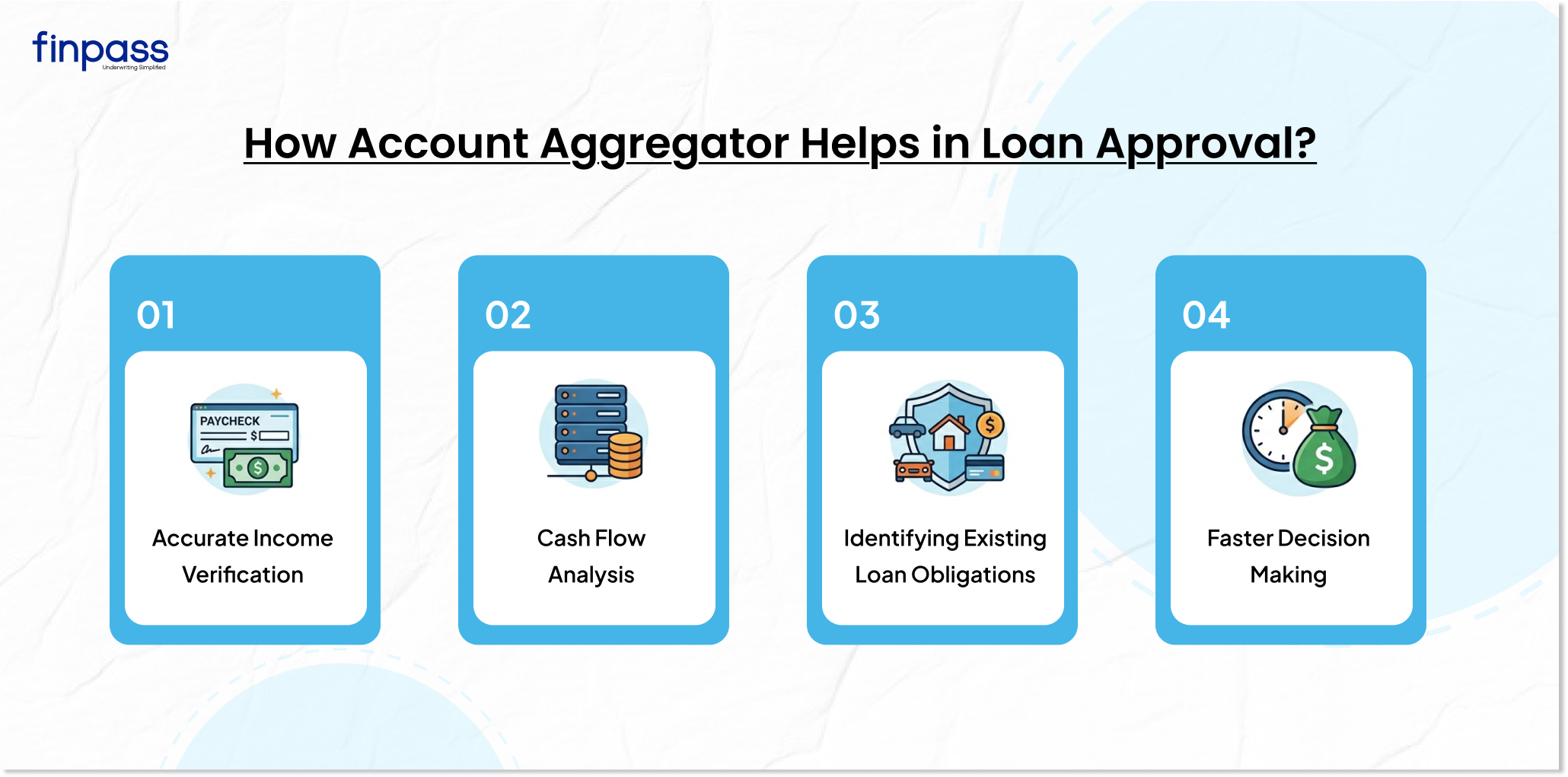
An Account Aggregator can be an effective tool for both credit and underwriting teams. This is how it directly improves loan approval:
- Accurate Income Verification: Lenders can verify income sources from bank records. They are able to easily determine how much a customer is earning monthly, and therefore, income assessment is shrewd.
- Cash Flow Analysis: It helps banks to determine where the user is spending their money. This helps to understand the usage of utility bills, shopping habits as well as overall cash flow patterns.
- Identifying Existing Loan Obligations: Lenders can quickly determine whether a customer is paying EMIs for loans. If a customer has several active loans or is frequently subject to bounce fees, the solution will alert them instantly.
- Faster Decision Making: Since the data is clean and well-organized, AI algorithms can process it quickly. Loan providers can instantly calculate the amount of money a user can repay. This converts a lengthy manual process into a quick decision.
Who Can Benefit from Account Aggregators?
Account Aggregator is designed to help various financial businesses, including:
- Banks and NBFCs: To process personal home loans, personal loans, and business loans more quickly without the need for paperwork.
- Digital Lenders: To provide instant loans via apps by confirming bank details in real-time.
- BNPL (Buy Now Pay Later) Platforms: For a quick assessment of the user’s spending patterns and to determine the amount of credit at the time of the checkout.
Why Choose Finpass Account Aggregator?
Finpass Account Aggregator has been designed to make access to financial data easy, quick and extremely reliable for BFSI using AI-powered tools. Finpass has all the features that businesses require to enhance their underwriting process.
- With Finpass, you get instant access to bank statements as well as real-time data retrieval and consent-based and secure data sharing that gives AI-powered results
- It eliminates the need to manually check documents and gives well-structured information.
Conclusion
Access to financial data is essential for all businesses in the BFSI sector. The manual collection of this information using PDFs can be slow and risky, and leads clients to withdraw their applications. An Account Aggregator makes it easier to manage the entire procedure. It transforms manual, messy documents into a seamless, quick, secure, and immediate digital experience.
Using an Account Aggregator, companies can simplify the financial assessment process, avoid fraud, and make loan approval faster. Finpass provides a reliable and easy-to-use digital solution that provides lenders accurate information they require, precisely when they require it.
FAQs
Ques: What is an Account Aggregator?
Ans: It is a digital solution that helps BFSI businesses in lending and underwriting by giving a user’s financial details instantly
Ques: Does it keep the user’s data safe?
Ans: Yes. It uses high-level encryption and follows strict RBI rules to make sure your information stays private.
Ques: How does Account Aggregator help in approving loans faster?
Ans: Account Aggregator makes loan approval faster by giving a complete view of a person’s financial status in real-time.
Ques: What if the customer has accounts in three different banks?
Ans: An Account Aggregator can pull data from all the different banks of a person at once. Presenting you all the financial information on a single dashboard.
Ques: How does Account Aggregator ensure data protection?
Ans: Account Aggregator ensures data protection by using high-level encryption and not storing user’s financial information.