Analyzing the overall growth of an organization can be done using a comparative statement. It helps investors and managers understand the business growth, profit, and losses over a period of time. Here, in this guide, you will learn about comparative statements in detail.
What is a Comparative Statement?
In simple words, it is a financial document that checks the company’s financial performance across different periods. It helps you analyse changes in business performance such as revenue, expenses, and profits.
The key documents used for comparative statements are the income statement, balance sheet, and cash flow statement.
Types of Comparative Statements
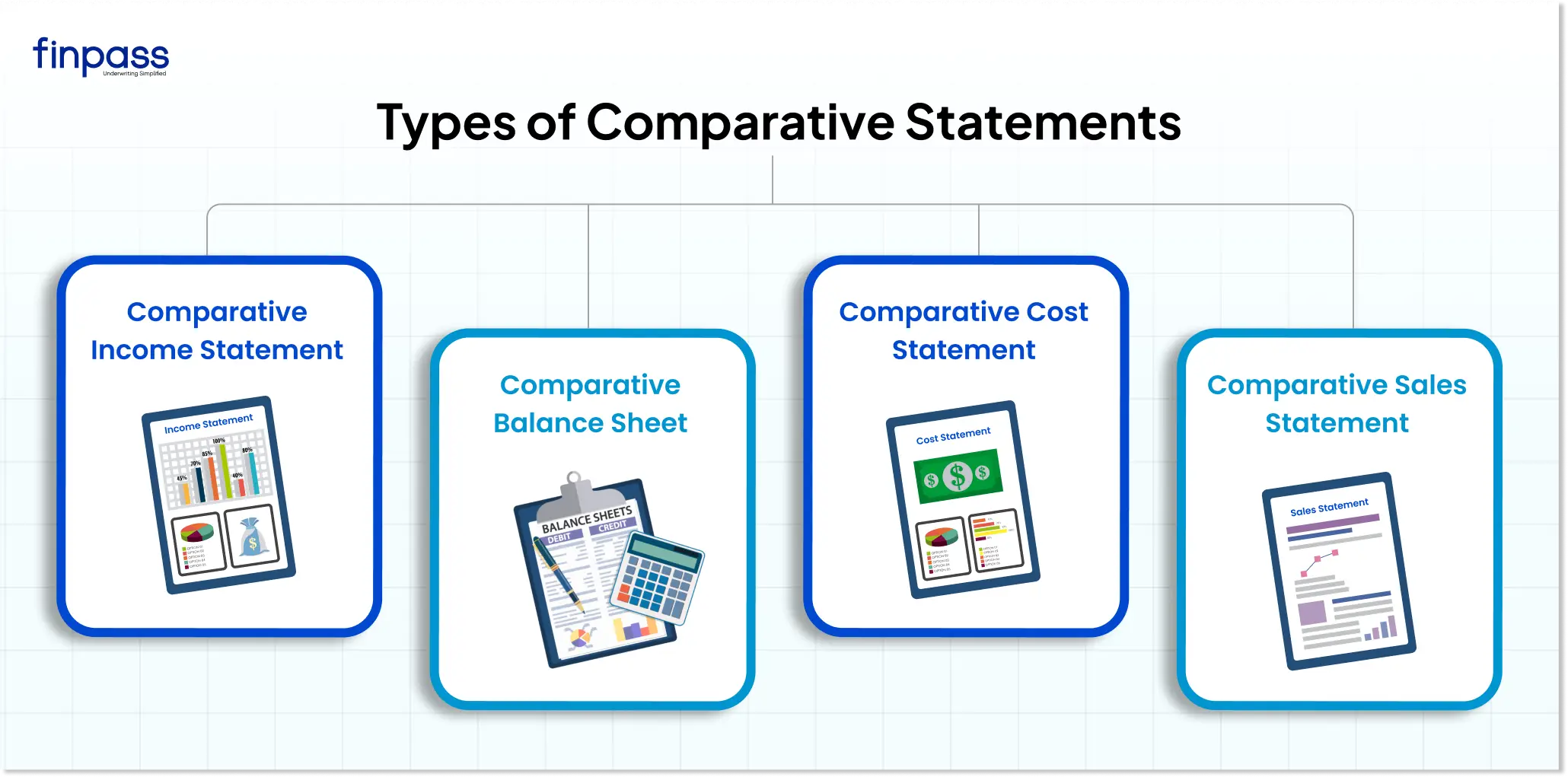
Here are the main types of comparative statements:
Comparative Income Statement
A comparative income statement is also known as a profit and loss statement. It shows revenue, expenses, and profit figures for two or more periods. Its main purpose is:
- Analyzing growth in sales and profit.
- Track changes in expenses.
- Evaluate overall profitability trends.
Comparative Balance Sheet
This statement compares a company’s financial position (assets, liabilities, and equity) across different periods. Its main purpose is to:
- Understand changes in financial health
- Track asset growth or decline
- Analyze debt and equity structure
Comparative Cost Statement
It is mainly used in cost accounting to compare cost components over a time period. Its main purpose is:
- Track cost changes.
- Control production and operational costs.
Comparative Sales Statement
It focuses on comparing sales performance across periods, regions, or product lines. Its main purpose is:
- Identify sales growth trends.
- Analyze product or region-wise performance.
- Support strategic decisions.
How to Prepare a Comparative Statement?
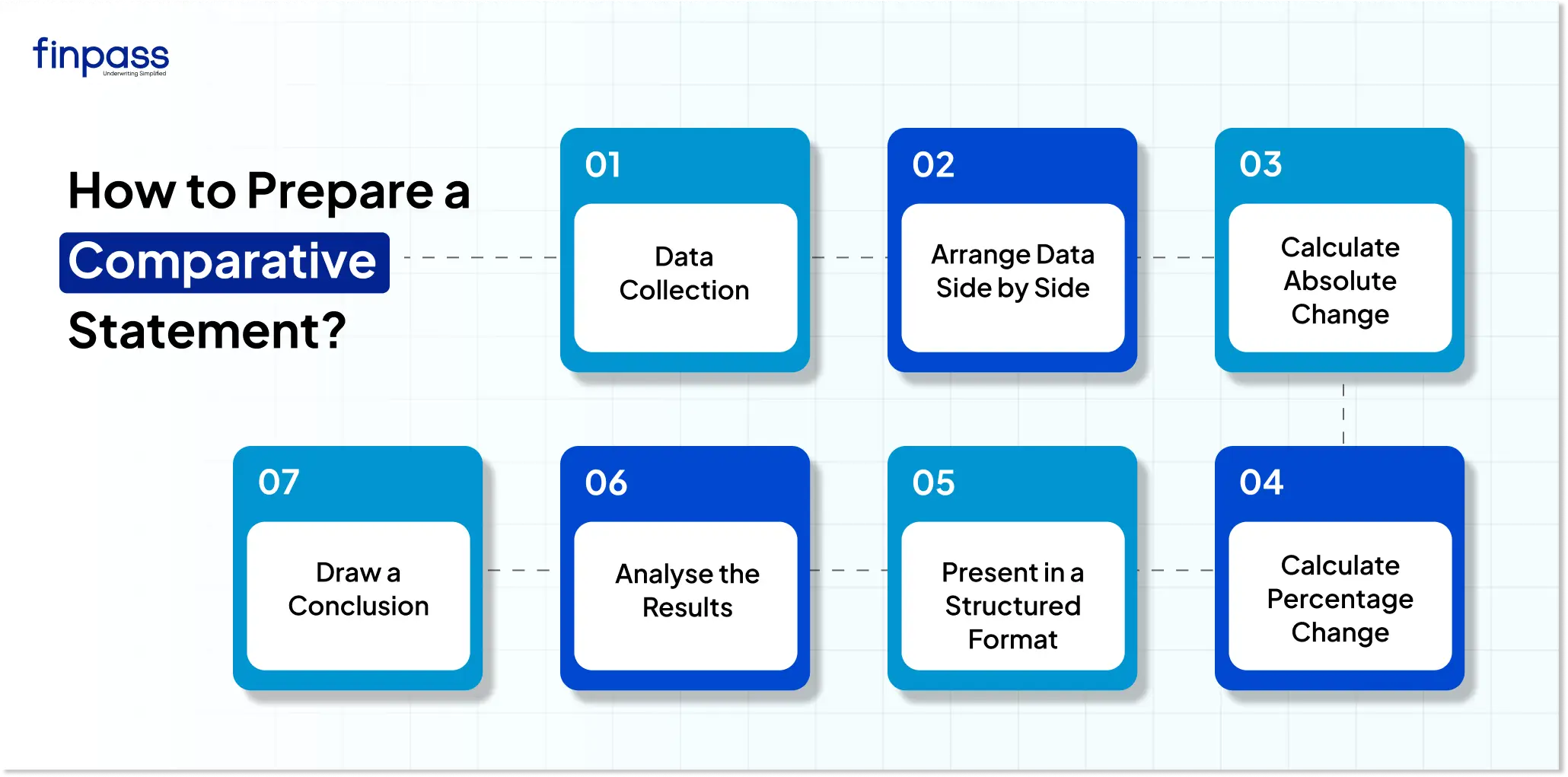
Here are the steps to prepare:
Step 1: Data Collection
Collect the financial statements of at least two accounting periods. It includes the income statement, balance sheet, and cash flow statement.
Step 2: Arrange Data Side by Side
Now put financial data (revenues, expenses, assets, and liabilities) in rows and place different years in adjacent columns.
Step 3: Calculate Absolute Change
Find the difference between the current year and the previous year.
Formula:
Absolute Change = Current Year − Previous Year” (capitalization consistency)
Step 4: Calculate Percentage Change
Now, you need to convert the change into a percentage to understand the growth rate:
Formula:
Percentage Change = (Absolute Change / Previous Year) × 100
Step 5: Present in a Structured Format
In this step, add columns for Absolute Change and Percentage Change
Final Format:
Particulars | 2023 | 2024 | Change | % Change |
Revenue | 5,00,000 | 6,00,000 | +1,00,000 | 20% |
Expenses | 3,00,000 | 3,50,000 | +50,000 | 16.6% |
Profit | 2,00,000 | 2,50,000 | +50,000 | 25% |
Step 6: Analyse the Results
Evaluate the data to find trends:
- Is revenue increasing consistently?
- Are expenses growing more than sales?
- Is profit increasing or declining?
Step 7: Draw a Conclusion
At last, summarize all key details, including growth trends, financial strength and weakness, and the areas that need improvement.
What are the benefits of a Comparative Statement?
There are various benefits of these statements:
- Trend Analysis: It helps in identifying financial data, such as growth or decline in profitability and financial position over the years.
- Performance Analysis: It helps in comparing current performance with past performance.
- Highlights Strengths and Weaknesses: Comparison helps businesses identify whether they are performing well or need improvement.
- Simplifies Financial Analysis: It provides a structured presentation of business financial information. It makes the analysis quicker and more understandable.
- Useful for Stakeholders: Investors, creditors, and management can easily check the company's financial health, credit risk, and growth.
- Detects Abnormal Changes: It helps identify unusual patterns (e.g., a sudden drop in profit or a spike in expenses).
Difference between Common Size and Comparative Statement
Both of these statements help in analysing financial statements:
Basis | Comparative Statement | Common Size Statement |
Meaning | It shows financial data of multiple periods side by side | Shows financial data as a percentage |
Purpose | Analyse growth and changes over time | Analyze financial structure and composition |
Focus | Trend Analysis (increase/decrease) | Proportion analysis (relative size of items) |
Data Format | Absolute figures + Percentage Change | Only Percentage (%) |
Time Comparison | It compares multiple accounting periods | It is usually used for a single period or a structural comparison |
Use Cases | Revenue Growth, cost changes, and performance tracking | Cost Structure, margin analysis, and benchmarking |
Decision Support | Strategic decisions (growth, expansion) | Efficiency decisions (cost control optimization) |
Complexity | Easy to understand | Requires analytical interpretation |
Example Insight | Profit increased by 15% YoY | Operating expenses are 30% of revenue |
Conclusion
Comparative Statement helps in checking the overall business growth and identifying suspicious patterns. It presents financial data side by side for multiple periods. It makes it easier to identify trends, measure growth, and detect any irregular changes in revenue, expenses, or profitability. It is useful for lending for underwriting before offering a loan or services.
FAQs
Ques: What is a Comparative Statement?
Ans: It is a financial document that presents data for multiple accounting periods side by side to analyze trends, performance, and financial position over time.
Ques: What is the objective of comparative statements?
Ans: It helps analyze financial position and performance over multiple periods to identify trends, evaluate business growth, and support decision-making.
Ques: What is Comparative Statement Analysis?
Ans: It is a financial tool that evaluates a company's performance by comparing financial data over different time periods.
Ques: What is the difference between a comparative and a common statement?
Ans: It compares financial data across multiple periods. In contrast, common size analysis converts figures into percentages of the base item to analyze component proportion in a single period.
Ques: What are the main types of comparative statements?
Ans: The main types include the income statement, the balance sheet, the profit and loss statement, and the sales statement.