Lending institutions face challenges like late payments, NPAs, and cash flow problems. It results in financial loss and strained customer relationships. This makes the credit decision the most essential part of lending. Because providing a loan to the wrong borrower increases the risk of defaults. Here in this blog, you will know about the Credit decision and credit decision management that helps businesses make the right credit decisions.
What is Credit Decision?
It is a process of evaluating a borrower’s creditworthiness. The goal is to determine whether to approve, reject, or adjust credit applications. It involves examining a range of factors related to the borrower’s ability to repay.
Credit decision-making helps financial institutions assess borrower risk and make better lending decisions.
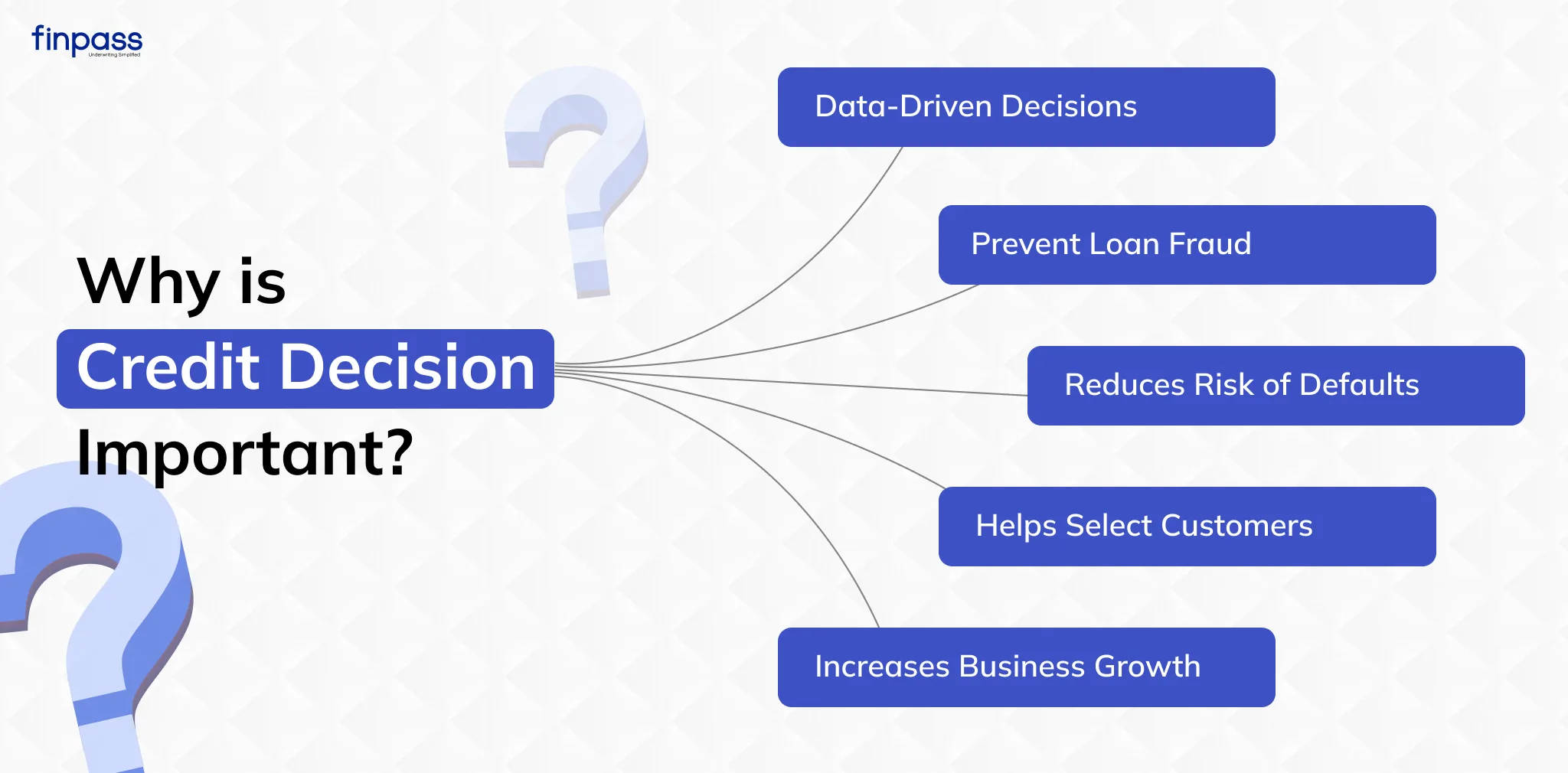
Why is Credit Decision Important?
It is essential for many reasons.
- Data-Driven Decisions: It uses data analytics and credit bureau information to assess capacity, collateral, and overall creditworthiness.
- Prevent Loan Fraud: It is used to identify fraudulent applications early in the customer lifecycle.
- Reduces Risk of Defaults: It helps lenders evaluate whether a borrower can repay the loan. It reduces the risk of NPAs (Non-Performing Assets).
- Helps Select Customers: It identifies the creditworthiness of the borrower based on financial behaviour. It improves the quality of the loan portfolio.
- Increases Business Growth: Smart lending decisions help retain profitable customers and support business growth
_.webp)
What are the main factors in Credit Decisioning ( 5 C’s)?
The 5Cs of credit is a framework used to evaluate a borrower's creditworthiness:
- Character: It is a process of checking borrowers' past credit behaviour, repayment history, and financial discipline.
- Capacity: It refers to checking the borrower's income and repayment ability, whether the borrower is able to pay the debt or not.
- Capital: It includes customers' assets and equity. The lending institution checks public financial statements to check the assets (financial and non-financial holdings).
- Conditions: This involves external factors like economic environment, industry trends, and loan purpose. It helps assess overall risk based on market conditions.
- Collaterals: Assets pledged as security (e.g., property, gold, vehicles). It reduces lender risk if the borrower defaults.
Types of Credit Decisioning
These are types of credit decisioning:
- Manual Credit Decisioning: In manual credit decisioning, a human, such as a credit analyst or loan officer. It involves reviewing income proof, bank statements, and credit history to approve or reject credit applications.
- Automated Credit Decisioning (AI/ML - Based): Automated credit decisioning uses technology such as AI, machine learning, and algorithms to evaluate a borrower’s data. It analyzes multiple data points like credit score, transaction history, and financial behaviour, and provides approval or rejection within seconds.
- Hybrid Credit Decisioning: Hybrid credit decisioning combines both manual and automated methods. Simple and low-risk applications are processed automatically.
What is Credit Decision Engine?
It is an automated system that evaluates borrower data through AI, Machine Learning, and predefined lending rules. It helps lenders make real-time decisions with minimal manual effort.
What are the Benefits of Credit Decisioning?
These are the benefits of credit decisioning:
- Reduces Credit Risk and Defaults: A proper credit decision helps lenders evaluate borrowers using financial data and credit history. It ensures that loans are given to individuals or businesses with strong repayment capacity and a lower chance of default.
- Smarter Decisions: Structured and automated credit decisions speed up the approval process. It reduces manual effort and allows businesses to make quick lending decisions.
- Support Better Risk Management: It helps in finding high-risk borrowers. It allows lenders to adjust terms, ask for collateral, or reject applications.
- Regulatory Compliance: A well-defined credit decision process follows legal and regulatory guidelines.
- Optimizes Credit Decisions: It ensures that funds are distributed efficiently to the most deserving borrowers. It helps businesses maintain liquidity and utilize resources.
What is Credit Decision Management?
It is the use of systems, workflows, and technologies to automate and optimize the credit approval process. It helps lenders maintain consistency, efficiency, and reduce credit risk across the lending lifecycle.
Future of Credit Decisioning
In the future, credit decisioning will become faster, smarter, and more data-driven with advanced technologies. AI & Machine Learning allow systems to analyze large volumes of data, detect patterns, and make accurate risk predictions with minimal human intervention.
The real-time analysis helps lenders make instant decisions by processing live data, enhancing customer experience, and reducing approval time. Alternative data usage, such as utility payments, digital transactions, and social behaviour, helps improve credit assessment. Automated decision-making transforms the lending ecosystem with end-to-end automated, consistent, and scalable credit decisions.
Conclusion
Credit decision is a process of checking the repayment capability of a borrower. It is an essential part of lending. It is a structured process where a lending institution checks various factors before providing a loan to a person. It reduces the risk of NPAs and defaults. The manual process is time-consuming; Automation makes the process faster and more efficient.
FAQs
Ques: What is the meaning of Credit Decision?
Ans: It is a process of checking borrowers' repayment capabilities. It helps in deciding whether to approve, reject, or modify a credit application.
Ques: What are the 5Cs of the credit decision?
Ans: The 5Cs are Character, Capacity, Capital, Condition, and Collateral.
Ques: What is the credit decisioning process?
Ans: It involves several processes:
- Data Collection
- Risk Assessment
- Decision
- Monitoring
Ques: What is credit decision management?
Ans: It is a management that refers to the use of systems, policies, and tools to automate and optimize credit decisions across the lending lifecycle.
Ques: What is credit exposure in lending?
Ans: It is the total risk a lender faces if a borrower defaults. Formula: Outstanding principal + accrued interest + potential future drawdowns.