Lending businesses, including NBFCs, Banks, and Fintech companies, provide loans to businesses and individuals. It increases economic growth and financial inclusion. They provide loans after a thorough analysis of the borrower's ability to repay loans. Incorrect evaluation can lead to defaults, financial losses, and an increased fraud risk. ITR is a reliable document because it provides details such as income, financial history, and tax compliance. It helps lenders and makes informed decisions.
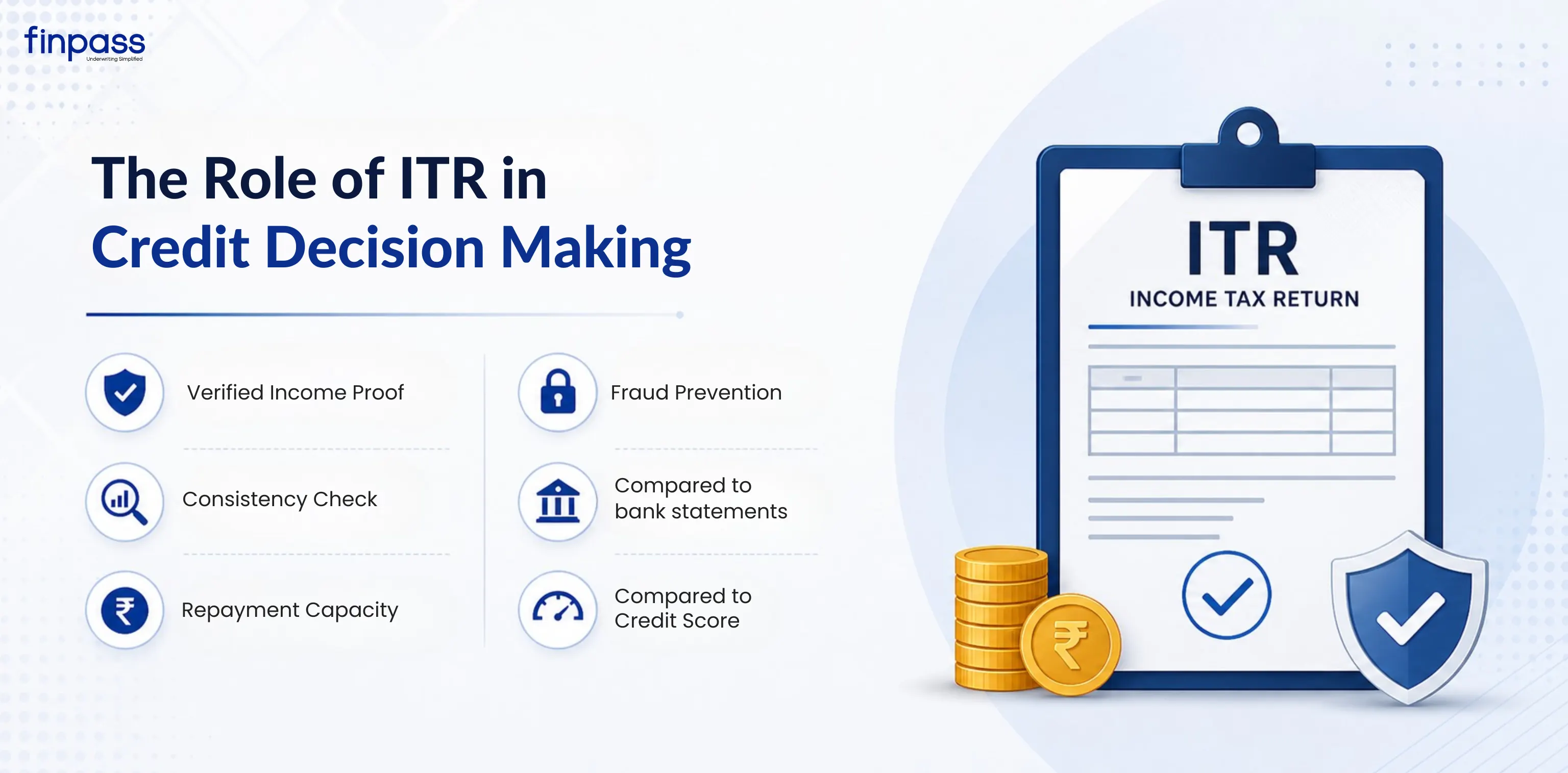
What is the role of ITR in Credit Decision Making?
Analysis of Incomer Tax Returns helping lending businesses in:
- Verified Income Proof: ITR provides officially reported income, helping lenders check borrower credibility and reduce reliance.
- Consistency Check: Multi-layer ITR filings reveal income stability, financial discipline, and transparency.
- Repayment Capacity: It helps lenders check how much a borrower can repay without stress.
- Fraud Prevention: It matches declared income with the government records. It minimises manipulation risk.
- Compared to Bank Statements: ITR shows how long approvals, limits, and pricing decisions take.
- Compared to Credit Score: Credit Score shows repayment capacity, whereas ITR shows earning capacity.
Challenges with Traditional Manual ITR Analysis
These are challenges a lending firm faces while manually reviewing ITR Analysis:
- Time-Consuming Process: In the manual ITR Analysis process, you need to review multiple pages, extract financial details, and interpret different income sections. It increases turnaround time and delays loan approvals.
- High Chance of Human Error: Manual data entry and data analysis lead to errors such as incorrect income calculations, missed deductions, or misclassification of financial information. Minor mistakes can result in inaccurate credit assessments.
- Limited Fraud Detection: Identifying fake or manipulated ITR documents manually is difficult. It can increase the risk of approving fraudulent applications.
- Scalability Issues: It is not designed to handle a large volume of applications. As the number of loan requests increases, businesses need to hire and train more analysts. It increases operational cost and slows the growth process.
- Inefficient Data Structuring: Borrowers submit ITR information in PDFs or unstructured formats. It makes it difficult for lenders to organize and analyse data efficiently. Extracting meaningful insights from such documents requires additional effort and time.
How does Automated ITR Analysis Solve These Challenges?
Automated ITR Analysis reduces inefficiencies of manual processing through AI and data extraction technologies to instantly read and interpret tax return data. It reduces human errors, speeds up the verification process, and ensures consistent evaluation across applications.
It helps lenders quickly verify income, detect discrepancies, and check financial stability in real time. It helps in handling a large volume of applications and operation efficiency.
What is Automated ITR Analysis?
Automated ITR Analysis is a process where AI, machine learning, and data extraction tools to automatically read, interpret, and analyse Income Tax Return (ITR) documents to check ITR information.
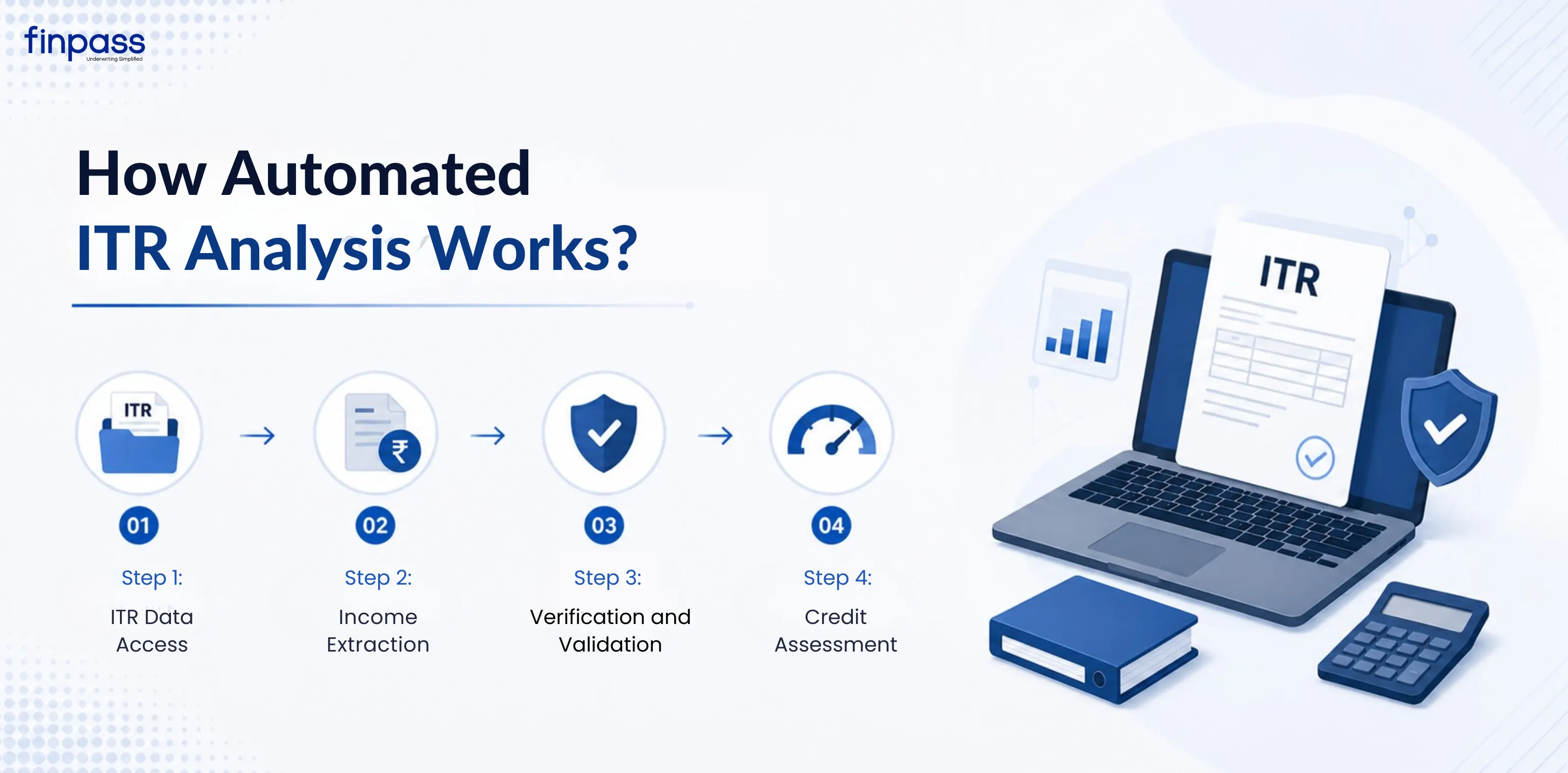
How Automated ITR Analysis Works?
There are many ITR Analysis solution are available online. Here is how Finpass ITR analyser works;
Step 1: ITR Data Access
It accesses ITR documents and Form 26AS from the Income Tax Portal with user authorization.
Step 2: Income Extraction
AI extracts salary, business income, capital gains, and other income, and sources ITR data.
Step 3: Verification and Validation
Cross-verify declared income with TDS records. Form 26AS and other government databases.
Step 4: Credit Assessment
It thoroughly analyses ITR and generates income stability scores, tax compliance ratings, and creditworthiness reports.
Finpass ITR Analyser for Automated ITR Analyser
The Finpass ITR Analyser is designed to help lending businesses automate the ITR Analysis process. It simplifies the ITR evaluation process and eliminates manual analysis.
Key Features of Finpass ITR Analyser
- Instant ITR Data Extraction: It eliminates manual data entry and reduces processing time significantly.
- Intelligent Verification and Validation: The system cross-verified declared income with TDS and other tax data to identify discrepancies. It helps lenders detect fraud and ensure compliance.
- Income Stability and Credit Insights: The solution analyses prior ITR data and provides insights, including income trends, financial stability, and tax compliance scores.
Conclusion
ITR Analysis is a crucial process in lending for evaluating the creditworthiness of a borrower. However, the traditional manual ITR analysis is time-consuming, error-prone, and unable to handle a large volume of applications. Using the Automates solution helps businesses check creditworthiness in less time and make the right decision with accurate information and trends.
FAQs
Ques: What is Automated ITR Analysis in Lending?
Ans: It is process of using an AI-equipped solution to extract and analyse ITR (Income Tax Return) data.
Ques: How does Automated ITR Analysis help in fraud detection?
Ans: It identifies mismatches, anomalies, and suspicious ITR information that helps detect fraud.
Ques: What challenges does Automated ITR Analysis solve?
Ans: Automated ITR Analysis solves issues like:
- Time-consuming manual processes
- Human errors in calculations
- Difficulty in detecting fraud
Ques: How is ITR Analysis different from credit score evaluation?
Ans: A credit score shows past repayment behaviour. ITR Analysis gives the actual earning capacity and financial health.
Ques: What is the ITR Analysis for Credit Underwriting?
Ans: It is a process of checking borrowers’ submitted tax returns to verify income, financial stability, and tax compliance to check repayment capacity.