.png)
India’s rural areas are the backbone of the economy. About 65% of India’s population lives in rural areas, and agriculture contributes over 15% of GDP. This shows that the demand for financial services is huge. Many rural borrowers are thin-file customers with limited credit history, no salary slips, and irregular income cycles. So, if you want to win this market, you need a fundamentally different approach to credit assessment.
What is Rural Credit?
Rural Credit refers to the financial assistance a rural borrower receives for agricultural and rural business purposes. Farmers use rural credit to finance seasonal agricultural and allied activities to invest in and buy things for a healthy harvest.
Why is Rural Credit important both for borrowers and Lenders?
Rural farmers and workers have seasonal or irregular income. If farmers get easy loans, they can buy good-quality seeds, produce more crops, earn more, and repay on time; however, due to limited credit history.
Benefits for Rural People
- Help farmers purchase seeds, fertilizers, and equipment.
- Supports irrigation and infrastructure development.
- Allows rural entrepreneurship and self-employment.
- Reduces financial dependency on local money lenders.
This segment is a good opportunity for banks and lending institutions to provide lending services to borrowers with proper credit risk management.
Types of Rural Credit in India
Rural credit is mainly classified into three categories based on duration and purpose:
Short Term Credit (0 to 1 Year)
Short-term loans are provided for seasonal agricultural activities such as:
- Buying seeds and fertilizers
- Paying labor wages
- Purchasing pesticides
- Cultivation Expenses
Medium Term Credit (1 to 5 Years)
It is used for purposes like purchasing farming tools, repairing irrigation systems, buying livestock, and small-scale agricultural improvements. Their repayment periods range from 1 to 5 years.
Long-Term Credit (5 to 20+ Years)
Long-term credit is used to support investments like buying tractors, land development, warehouse construction, or setting up dairy or poultry farms. These loans have longer repayment terms.
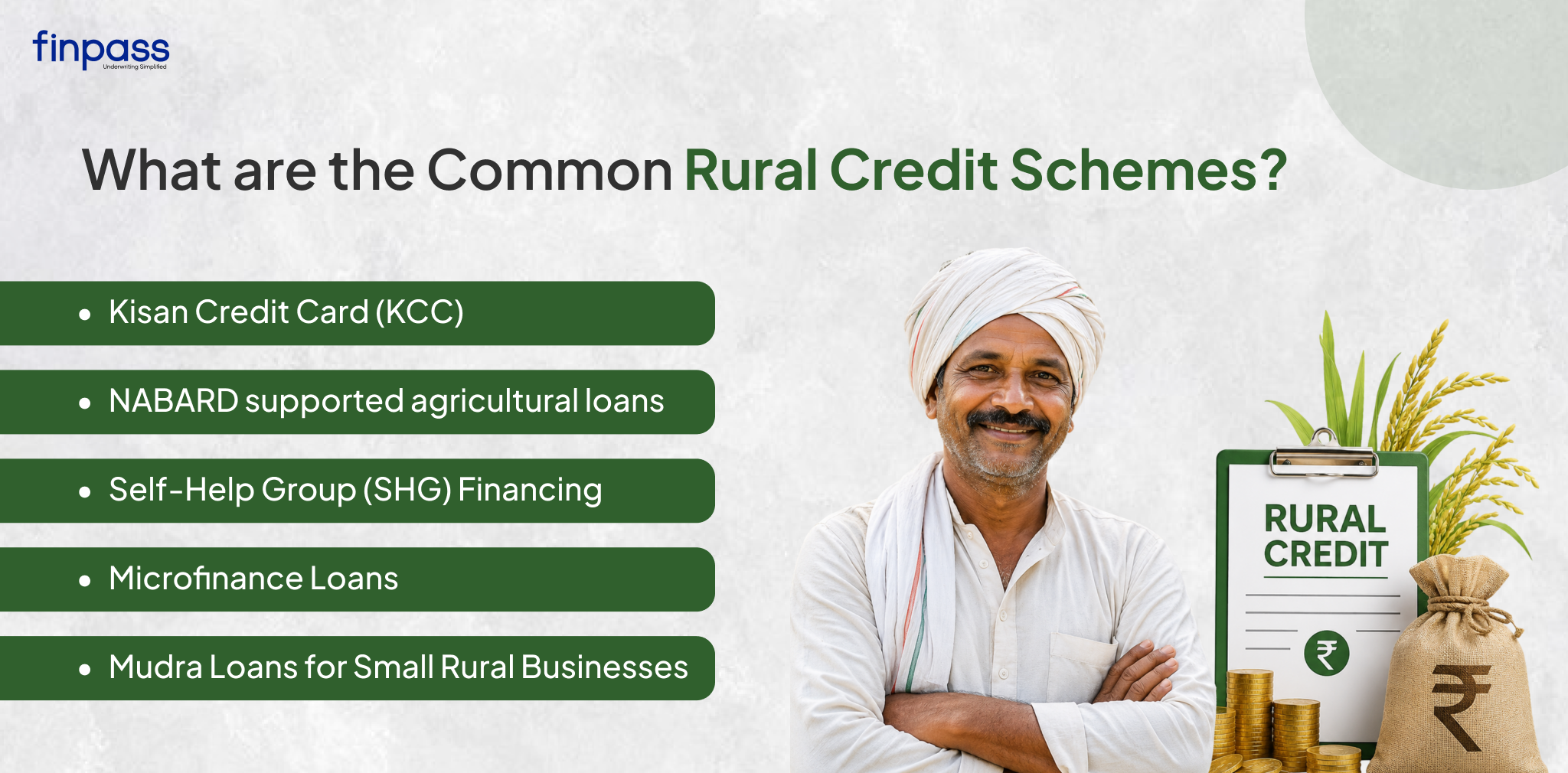
What are the Common Rural Credit Schemes?
The common credit schemes include:
- Kisan Credit Card (KCC)
- NABARD supported agricultural loans
- Self-Help Group (SHG) Financing
- Microfinance Loans
- Mudra Loans for Small Rural Businesses
What are the main sources of Rural Credit?
In rural India, borrowers obtain money from both institutional and non-institutional sources:
Institutional Sources
Institutional sources refer to the formal credit sector, which includes the RBI (Reserve Bank of India) and NABARD (National Bank for Agricultural and Rural Development). This includes:
- Commercial Banks
- Co-Operative Banks
- Regional Rural Banks
- NABARD
Non-Institutional Sources of Rural Credit
These are lenders that are not officially controlled or monitored by the government or banking authorities. They provide quick loans with fewer formal requirements. However, these sources offer high interest rates. It also has other issues, like unfair repayment terms or pressuring borrowers through unethical methods.
Moneylenders
- Friends and Relatives
- Landlords
- Traders and shopkeepers
Why is Rural Lending Hard?
Rural lending challenges arise mainly from limited financial documentation and informal income patterns. It is difficult because they lack credit history for risk assessment like no salary slips, no CIBIL score, no stable income source, unpredictable returns due to disasters, lack of documents, dependency on the village moneylender, and hidden debts.
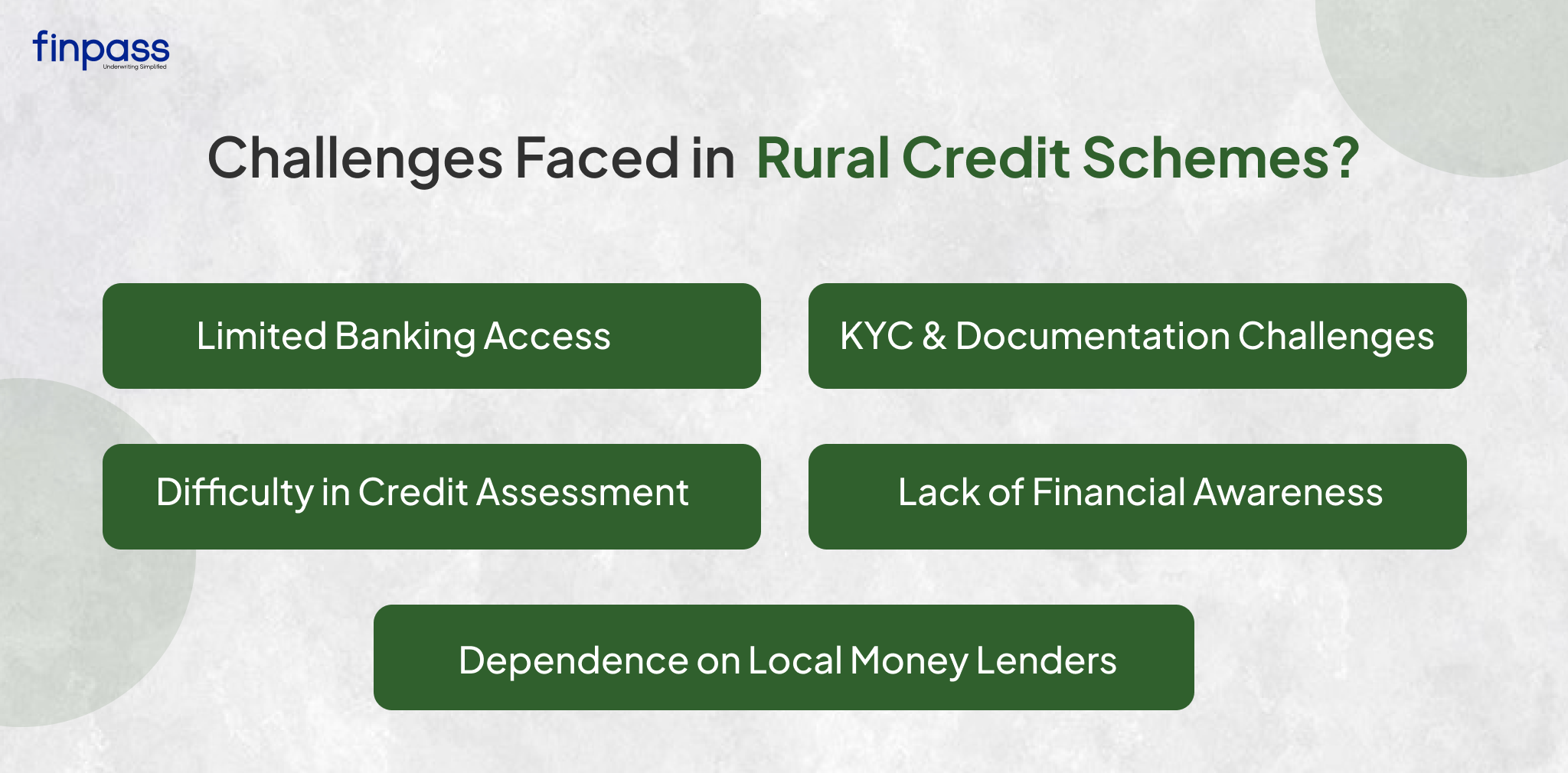
Challenges Faced in Rural Credit Distribution
Even though the government has launched various schemes and banking initiatives, rural credit distribution still faces many challenges:
- Limited Access to Formal Banking: Many areas have no banking services available.
- Documentation Issues: Rural borrowers face difficulties in KYC documentation, income proof, and identity verification requirements.
- Dependence on Informal Lending: Many borrowers are still unaware of these services and rely on the local money lenders.
- Credit Risk Assessment: Financial institutions find it difficult to evaluate the creditworthiness of rural borrowers because of limited financial records.
How Technology is Transforming Rural Credit?
The digitalization enhances the rural lending processes as rural borrowers also use online transactions. Now, financial institutions are using automation, AI-powered verification, digital KYC, and alternative credit assessment methods.
Here, Finpass helps ease credit decision-making in lending with smart solutions like SMS Analyser, Bank Statement Analyser, and Underwriting IQ. With these solutions, lenders can access and check the financial health of thin-file customers.
Conclusion
Rural Credit is essential for agricultural growth, rural development, and financial inclusion in India. It supports farmers and rural entrepreneurs. The rural sector is a major opportunity for lending institutions to generate profits. Providing rural credit is difficult due to lack of formal credit history, documentation issues, and other challenges. The AI automated solution help in analysis and credit decision.
FAQs
Ques: What is rural credit?
Ans: It refers to loans and financial assistance provided to people in rural areas for agriculture, farming, livestock, and rural business activities.
Ques: What are the sources of rural credit?
Ans: Commercial banks, cooperative banks, RRBs, and NARABARD as well as non-institutional sources such as moneylenders and traders.
Ques: What are thin-file customers?
Ans: A thin-file customer is a borrower with little formal financial or credit history.
Ques: What is NABARD in Rural Credit?
Ans: NABARD (National Bank for Agriculture and Rural Development) is a government financial institutions that support rural development and agriculture in India.
Ques: What is agricultural credit?
Ans: It is a type of rural credit provided specially for farming and agricultural activities.
Ques: What are non-institutional sources of Rural Credits?
Ans: The non-institutional sources are:
- Moneylenders
- Friends and relatives
- Landlords
- Local Traders