Financial Analysis helps in checking a company's financial health in a specific period. It identifies trends and helps assess equity securities, financial risks, and performance. It helps perform due diligence before a prospective merger or acquisition. The tools of financial statement analysis simplify a company's financial analysis.
What is Financial Statement Analysis?
It is the process of checking a company's financial reports, such as the balance sheet, income statement, and cash flow statement. These reports are used to evaluate the financial health, profitability, and future performance. It is simple; it is used to check whether the company is making a profit or incurring a loss. Is the company growing or declining?
Tools of Financial Statement Analysis
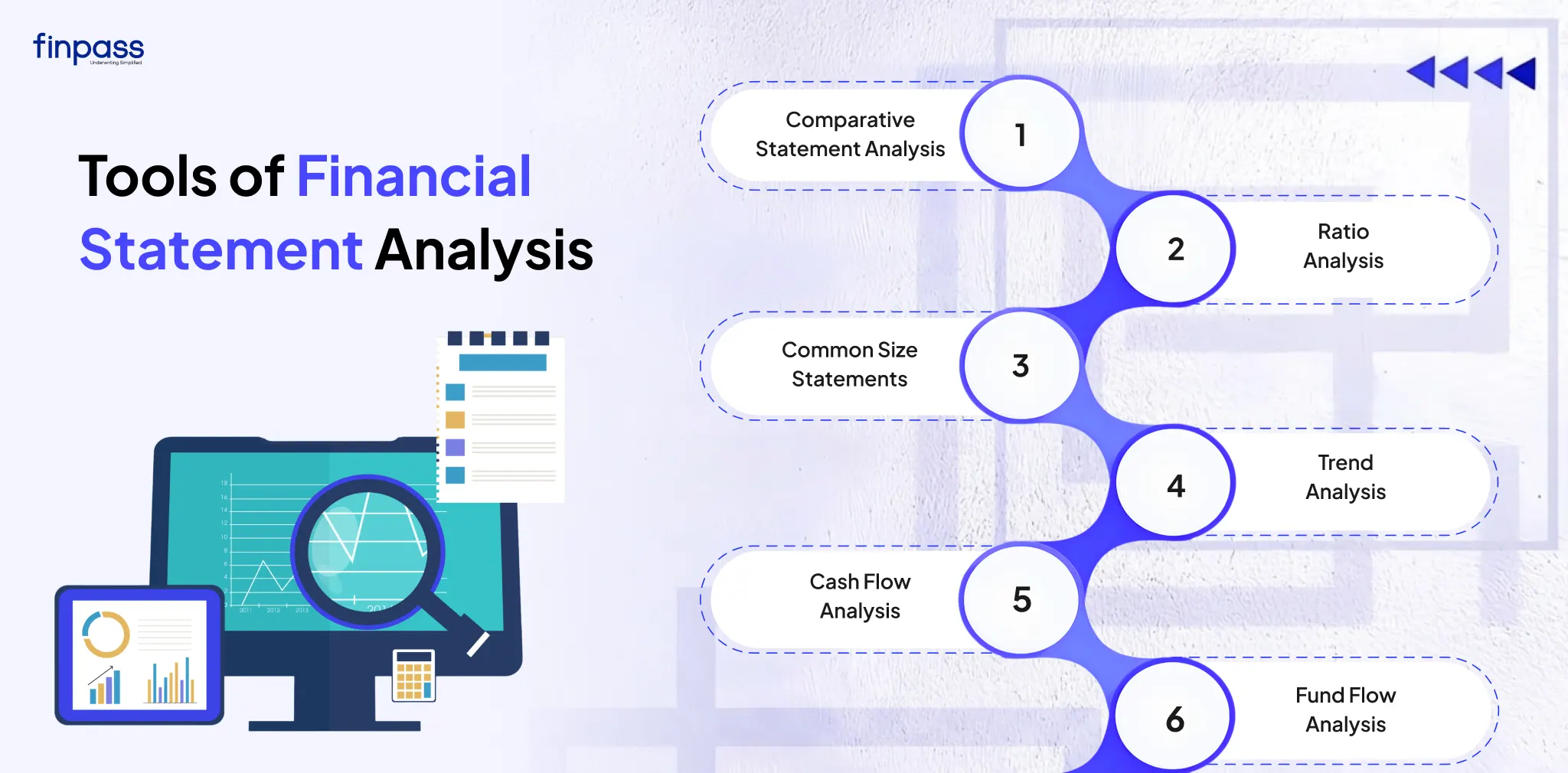
These are tools used for analyzing the financial statements of a business:
Comparative Statement Analysis
A comparative statement analysis is a process of comparing financial statements (income statement and balance sheet) of different periods. Its main purpose is to understand company growth trends, performance trends, and identify financial changes.
Ratio Analysis
It is a financial tool used to check a company's performance and financial health. It calculates various ratios from its income statement and balance sheet. It helps measure profitability, liquidity, solvency, and efficiency. It helps investors, lenders, and management understand a company's weaknesses and compare performance.
Common Size Statements
Common-size statements are financial analysis tools. It helps convert line items in financial statements into percentages of a base figure. It uses vertical analysis and allows comparison between companies of different sizes or over different periods.
Trend Analysis
It focuses on checking financial data over several periods. It identifies patterns or directions in performance. It is used to predict future outcomes. It helps businesses make proactive, data-driven decisions and reduce the risks of fraud.
Cash Flow Analysis
It checks the inflow and outflow of cash within a business during a specific period. It provides information about the company’s liquidity and its ability to pay operating expenses, repay debts, and invest in growth.
Fund Flow Analysis
It studies the movement of funds between two balance sheet dates to understand changes in financial position. It helps identify the sources from which funds are generated.
Budgetary Control
It includes creating operational budgets and comparing them to actual results to assess performance. This process helps control costs, use resources efficiently, and reach organizational objectives.
Comparison of Financial Statement Analysis Tools
Tool | Purpose | Best For |
Comparative Statement | Compare Financial Data Over Different Periods | Analysts and Management |
Ratio Analysis | Measure profitability, liquidity, and solvency | Investors and Analysts |
Common Size Statements | Convert data into percentages for comparison | External Analysis |
Trend Analysis | Identify growth patterns over time | Long Term Planing |
Cash Flow Analysis | Analyze cash inflow and outflow | Lenders and Management |
Fund Flow Analysis | Track Movements of Funds | Financial Analysts |
Break-Even Analysis | Determine no-profit, no-loss point | Business Owners |
Budgetary Control | Compare budgeted vs actual performance | Management |
Horizontal Analysis | Analyze changes over multiple periods | Analysts |
Vertical Analysis | Analyze Components Within a Single Period | Internal Evaluation |
Benefits of Financial Statement Analysis
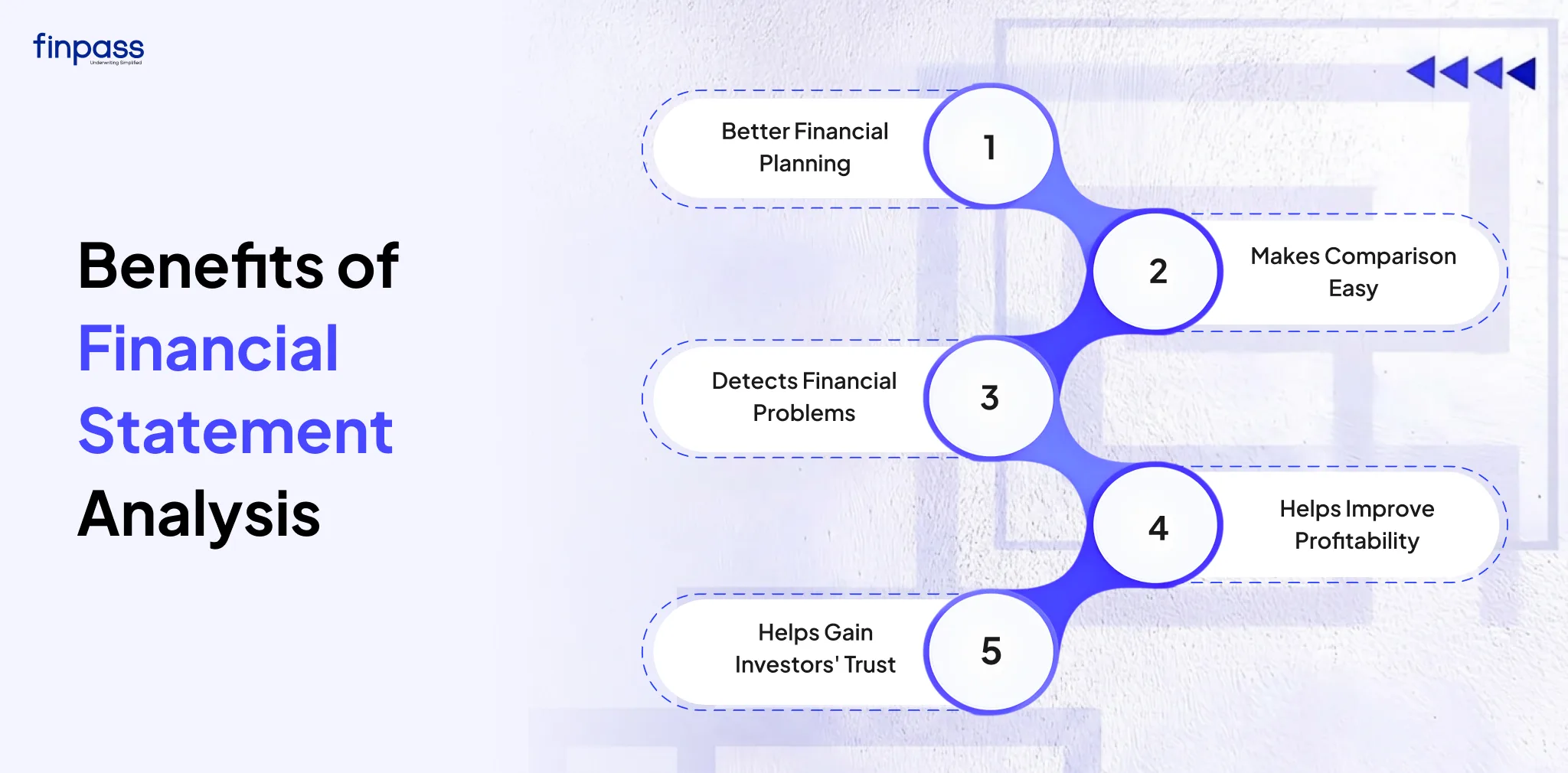
There are many benefits of using these analysis tools:
- Better Financial Planning: It helps businesses prepare effective financial plans. It helps identify income, expenses, and profits.
- Makes Comparison Easy: You can compare the financial performance of different companies or industries using ratios, trends and common-size statements.
- Detects Financial Problems: It helps detect issues like declining profits, rising debts, poor cash flows, or operational inefficiencies.
- Helps Improve Profitability: It analyses revenue, expenses, and profit margins. The thorough analysis helps identify areas for improvement.
- Helps Gain Investors' Trust: Clear financial analysis helps companies show financial stability and growth potential.
Limitations of Financial Statement Analysis
It is used to analyze companies’ performance; it also has several limitations:
- Based on Historical Data: This analysis process mainly uses past financial information. It does not accurately predict future performance.
- Ignores Non-Financial Factors: It does not consider factors like market competition, customer satisfaction, employee efficiency, or brand reputation.
- Accounting Methods: Different companies use different accounting policies, which makes comparison difficult.
- Inflation Impact: Changes in inflation and market prices may reduce the accuracy of financial analysis.
- Limited Qualitative Information: The financial statement analysis focuses on numbers. It does not explain the actual reasons behind performance changes.
- Time-consuming process: It is a detailed financial analysis that requires expertise, time, and proper interpretation of financial information.
Conclusion
It is financial analysis helps businesses, investors, lenders, and management. It helps you understand the company's financial position and performance. Tools such as ratio analysis, trend analysis, cash flow analysis, and Comparative Statement Analysis help identify strengths, weaknesses, and risks. It makes it easier to find strengths, weaknesses, and risks. Lenders and investors use this statement to make the right investment or lending decisions.
FAQs
Ques: What tools are used in financial analysis?
Ans: Comparative income statements, common size statements, Ratio analysis, trend analysis, and cash flow analysis are used in financial analysis.
Ques: What are the 5 financial statement analysis methods?
Ans: The commonly used financial statement analysis methods are horizontal analysis, vertical analysis, ratio analysis, trend analysis, and cash flow analysis
Ques: What are the three basic tools of financial analysis?
Ans: Horizontal Analysis (Comparative Statements), Vertical Analysis (Common Size Statements), and Ratio Analysis.
Ques: What are the objectives of financial statement analysis?
Ans: It helps in checking a company's profitability, liquidity, and solvency.
Ques: Which is the most commonly used financial analysis tool?
Ans: Ratio analysis is the most commonly used financial analysis tool because it measures profitability, liquidity, efficiency, and solvency.